
Attics, walls and crawl spaces in Washington County
Insulation Contractors in Beaverton, OR
Air sealing first, the right material for each space, and a written quote that shows the R-value you are paying for.
- Free on-site estimates with an attic and crawl space check
- Written, itemized quotes listing R-value, depth and square footage
- Air sealing and ventilation checked before insulation goes in
Insulation for Wet Winters and Older Homes
Insulation contractors in Beaverton work in a climate that is more damp than cold. The city averages about 39 inches of precipitation a year, most of it from November through February, and January nights average just under 34°F. Snow is rare, under 2 inches a year on average. That means long, gray heating seasons where warm, moist indoor air is always trying to escape into the attic and cold, wet air sits under the floor. Good insulation work here is as much about controlling air and moisture as it is about adding R-value.
A lot of Beaverton homes were built before today's code
Census figures summarized by Point2 show about 20% of Beaverton's housing built in the 1970s and 18% in the 1980s, with another 10% from the 1960s. Altogether, more than half of the city's homes went up before 1990. Many of those houses still have their original attic insulation, often a few inches of settled fiberglass or cellulose, and crawl spaces with batts that have sagged or fallen over the years. The current Oregon Residential Specialty Code, in effect since April 1, 2024, calls for R-49 in flat ceilings, R-30 under floors and R-21 in above-grade walls for new work. Older homes rarely come close.
Attic insulation does the most for the money
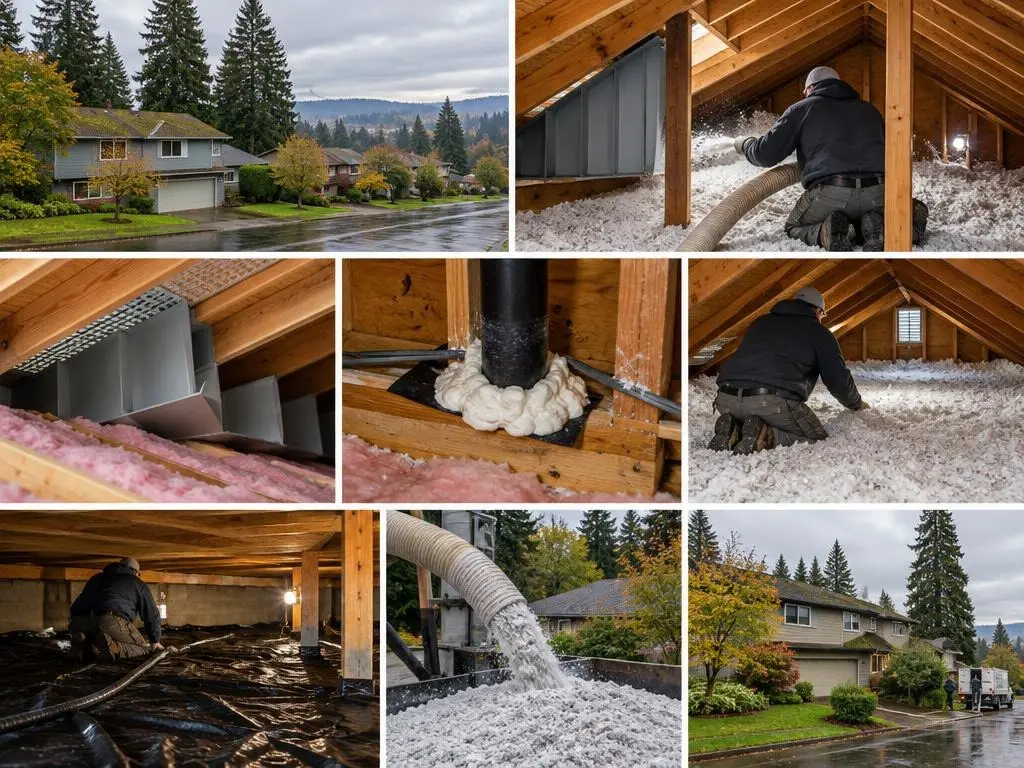
Heat rises, and the attic is usually the easiest place to add a lot of insulation. For a marine climate zone like ours, the U.S. Department of Energy suggests bringing an uninsulated attic to R-60 and an attic with 3 to 4 inches of existing insulation up to R-49. Most of our attic jobs use blown-in fiberglass or cellulose because it fills around joists, wiring and framing without gaps. Before any of it goes in, we seal the holes that let warm air leak up: top plates, wiring and plumbing penetrations, recessed lights rated for contact, and the attic hatch.
Spray foam insulation, used where it fits
Spray foam insulation seals and insulates in one step, which makes it the right choice for rim joists, cantilevered floors over garages, bonus rooms, vaulted ceilings with shallow rafters and some crawl space walls. Closed-cell foam runs about R-5 to R-7 per inch and also works as a vapor retarder; open-cell foam is about R-3.5 to R-3.7 per inch and costs less. It is not the answer for every attic, though. Blown-in insulation on the attic floor usually reaches the same R-value for less, and we will tell you when that is the better buy.
Crawl spaces in a rainy climate
Many Beaverton homes sit over vented crawl spaces. When the ground cover is torn or missing, moisture from the soil rises into the space, batts between the floor joists absorb it, get heavy and drop. That leaves cold floors and a musty smell. Crawl space work starts with the ground cover and any standing water, then insulation that stays in place: batts held up with supports, rigid foam or closed-cell spray foam, depending on the space.
Mice, rats and old insulation
Attics and crawl spaces are favorite nesting spots for rodents, and contaminated insulation should not simply be buried under new material. The CDC advises against sweeping or vacuuming rodent droppings or nesting material until it has been wetted with disinfectant, and says contaminated insulation should be bagged in plastic for removal. We remove soiled insulation, sanitize the area, recommend sealing the entry points with your pest control company, and then reinsulate.
Energy Trust of Oregon incentives
Energy Trust of Oregon has offered incentives for attic, wall and floor insulation to customers of Portland General Electric, Pacific Power, NW Natural, Cascade Natural Gas and Avista, usually with a maximum existing R-value and a minimum installed level. Amounts, eligibility and contractor requirements change, so check Energy Trust's current terms before you plan around an incentive. We can show you the existing and installed R-values on your quote so you have what the program asks for.
What a typical attic job includes
- Measuring existing insulation depth and identifying the material
- Checking for vermiculite, moisture stains, mold and rodent activity
- Sealing top plates, penetrations and the attic hatch
- Installing baffles at the eaves to keep soffit vents open
- Dams around the hatch, chimney and other heat sources as required
- Blowing insulation to the agreed R-value with depth markers in place
- A walk-through or photos of the finished attic
Why Homeowners Call Insulation Contractors Beaverton
Air sealing before insulation
Gaps around wiring, plumbing, lights and the hatch are sealed first, so the new insulation is not just a filter for leaking air.
The R-value in writing
Your quote lists the material, installed R-value, depth and square footage for each area, so you can compare bids line by line.
Moisture checked, not ignored
We look for roof leaks, bath fans venting into the attic and wet crawl spaces before insulating over a problem.
Material matched to the space
Blown-in where it gives the most R-value per dollar, spray foam where sealing matters, and batts or board where they fit best.
Where We Work
Beaverton is home base, including neighborhoods such as Central Beaverton, Denney Whitford, Five Oaks, Greenway, Highland, Sexton Mountain, South Beaverton, Vose and West Slope. From there we serve nearby Washington County communities and the west side of the Portland area, including Hillsboro to the west and Tigard to the south. The climate is much the same across the valley, but the housing is not: older neighborhoods closer to Portland tend to have 1950s to 1970s houses with thin attic insulation and uninsulated walls, while newer subdivisions to the west were built under later energy codes and more often need targeted work over garages and in bonus rooms. Hillside lots also tend to mean deeper, harder-to-reach crawl spaces. Each area page covers what applies there.
- Insulation Contractors in Beaverton, OR
- Insulation Contractors in Hillsboro, OR
- Insulation Contractors in Tigard, OR
- Insulation Contractors in Portland, OR
- Insulation Contractors in Lake Oswego, OR
- Insulation Contractors in Aloha, OR
- Insulation Contractors in Tualatin, OR
- Insulation Contractors in Sherwood, OR
- Insulation Contractors in West Linn, OR
- Insulation Contractors in Forest Grove, OR
- Insulation Contractors in Cornelius, OR
- Insulation Contractors in King City, OR
- Insulation Contractors in Bethany, OR
- Insulation Contractors in Cedar Mill, OR
- Insulation Contractors in Garden Home-Whitford, OR
- Insulation Contractors in Wilsonville, OR
- Insulation Contractors in Happy Valley, OR
- Insulation Contractors in Oregon City, OR
Our Insulation Services
Six services cover the insulation in most homes, from the attic down to the crawl space.
Attic Insulation
Air sealing, baffles and blown-in or batt insulation brought up to R-49 or more.
Learn more →Spray Foam Insulation
Open-cell and closed-cell foam for rim joists, bonus rooms, vaulted ceilings and crawl space walls.
Learn more →Blown-In Insulation
Loose-fill fiberglass or cellulose for attic floors and dense-pack for closed walls.
Learn more →Crawl Space Insulation
Ground cover, floor insulation that stays up, and sealed rim joists for warmer floors.
Learn more →Wall Insulation
Dense-pack for closed walls in older homes, and batts or foam when walls are open.
Learn more →Insulation Removal & Replacement
Old, wet or rodent-soiled insulation removed, the space sanitized and sealed, then reinsulated.
Learn more →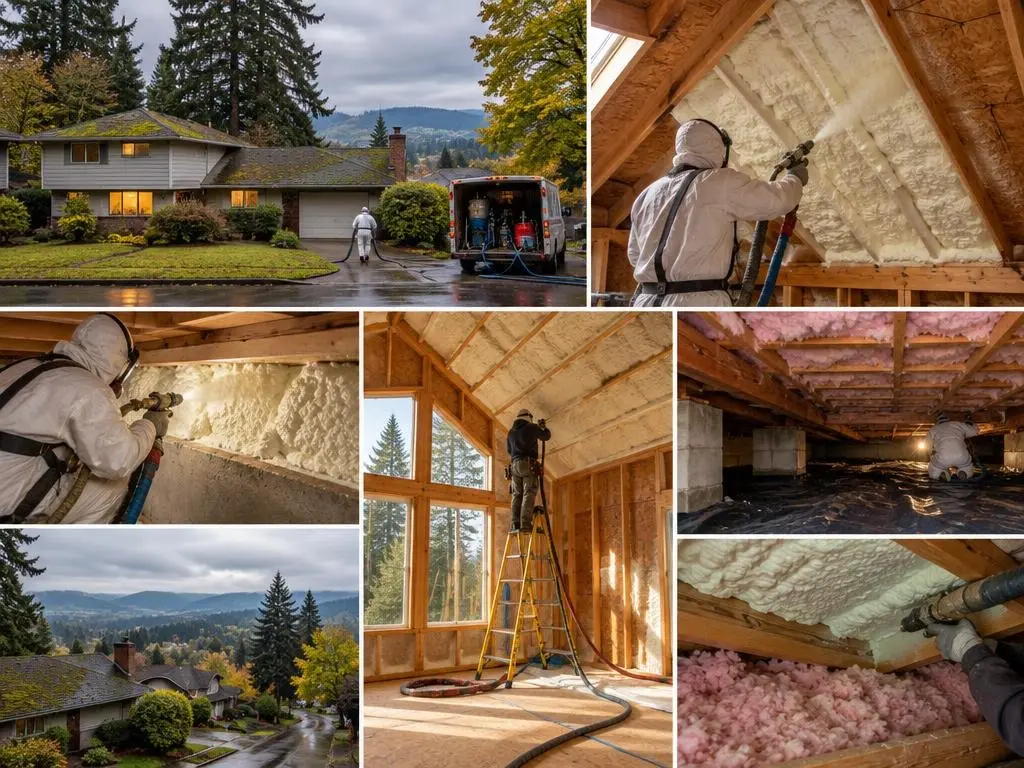
Common Questions
What are the recommended R-values for insulation in Oregon?
For new work, the 2023 Oregon Residential Specialty Code (effective April 1, 2024) calls for R-49 in flat ceilings, R-30 in vaulted ceilings, R-21 in above-grade walls, R-30 under floors and R-15 at slab edges. For existing homes, the Department of Energy suggests R-60 for an uninsulated attic in our marine zone, or R-49 if there are already 3 to 4 inches. Those are targets, not requirements for adding insulation to an existing attic.
How much do insulation contractors charge in Beaverton?
HomeGuide's 2026 guide puts attic insulation at about $1,000 to $2,700 for a typical job, with blown-in at $0.90 to $2.40 per square foot and spray foam higher. Crawl space insulation commonly runs $500 to $3,700, and spray foam for a whole house $8,000 to $20,000. Removal of old insulation adds about $1 to $2 per square foot. These are national figures; we give a written price after seeing the house.
Why is spray foam insulation sometimes called a red flag?
Usually because of installation problems, not the material itself. Foam that is mixed or applied poorly can leave a lasting odor or pull away from framing, and HomeGuide notes occupants must stay out of the sprayed area for 24 hours or more while it cures. Some home inspectors and buyers also question foam sprayed on the underside of roof sheathing because it hides the decking from view. We use spray foam where it clearly does a better job and explain the trade-offs first.
What type of contractor installs insulation?
Insulation is installed by insulation or weatherization contractors, and sometimes by general contractors or drywall companies. In Oregon, construction contractors are licensed through the Construction Contractors Board, and you can look up any contractor's license on the CCB website before you sign.
Should I remove old insulation before adding new?
Not always. Dry, clean insulation can stay, and new material can go on top once air sealing is done. It should come out if it is wet, moldy, soiled by rodents, or blocks the air sealing that needs to happen. Vermiculite is a separate case: the EPA says to assume it contains asbestos and not disturb it.
Do you work with Energy Trust of Oregon incentives?
We can tell you which parts of a job are likely to fall under Energy Trust's insulation offers, which have been tied to existing R-value limits and minimum installed levels, and we list both on your quote. Energy Trust sets the amounts, eligibility and contractor requirements and they change, so confirm current terms with Energy Trust before relying on an incentive.
Is it worth insulating a crawl space in Beaverton?
Usually, yes, if the floors feel cold or the existing batts have fallen. In our wet winters, the ground cover matters just as much: fixing a torn or missing vapor barrier keeps soil moisture from soaking the new insulation. We check both at the estimate.
Get an Insulation Estimate
Free on-site estimates in Beaverton and across Washington County.